How to Clean a Safety Razor Without Damaging It
An after-shave routine, a safe deep clean, and a way to handle stubborn residue without guessing at your razor's finish.
The buying shortlist
Gear for this guide
Use what you already own when it works. If you need gear or a replacement, start with these options.
As an Amazon Associate I earn from qualifying purchases. Affiliate disclosure
The short answer: rinse, dry, then clean buildup as needed
After each shave, rinse hair and lather from the head with warm running water, shake off excess water, and leave the razor somewhere clean and dry. When soap film collects under the cap, around the guard, or in the threads, remove the blade and wash the razor parts with mild dish soap and a soft brush. Rinse and dry the parts before reassembly. You do not need a chemical bath after every shave.
This is a general routine for a metal double-edge safety razor, not a substitute for the instructions supplied with your model. MERKUR's care guide recommends a rinse after each shave and a gentle periodic clean for its chrome-plated razors. MÜHLE's three-piece razor manual also allows running water and mild detergent, but instructs users to remove the blade before cleaning its razor. If your maker gives a more specific method, use it.
If this is your first shave, the beginner safety-razor guide shows how to load and use the head before the cleanup described here.
What to do after every shave
- Rinse the head while residue is still wet. Follow your model's blade-handling instructions first; MÜHLE's three-piece manual says to remove the blade before cleaning, including the after-shave rinse. Then let warm tap water pass through both sides of the guard until visible lather and hair are gone. Use a comfortable temperature; boiling water offers no routine benefit.
- Clear remaining water. Give the razor a gentle shake over the sink. Pat accessible handle and head surfaces with a soft cloth if your finish permits it, keeping fingers and cloth away from the exposed edge. MERKUR says its chrome razors may air-dry or be gently patted with a soft cloth; its gold-plated finish needs especially light handling.
- Store it where it can dry. A clean shelf or stand in a dry place is enough. Keep it secure and away from children and pets. Avoid sealing a wet razor in a travel case. MÜHLE calls for a safe, dry storage place.
A few remaining water droplets do not mean the razor needs to be dismantled after every shave. Inspect the head as you go: if soap remains trapped or you see discoloration developing, clean it sooner. Rockwell's care guidance notes that its stainless 6S can develop tea-colored marks when a blade is left in a wet razor for long periods; Rockwell advises removing the blade between uses if you notice that issue. That is model-specific advice, not a rule for every razor.
Do you need to buy a safety-razor cleaning kit?
Usually, no. Warm water, a small amount of mild dish soap, a soft toothbrush used only for cleaning, and a clean soft cloth cover routine maintenance for most simple metal safety razors. A branded cleaning solution, ultrasonic cleaner, polishing compound, razor stand, and lubricant are optional tools for specific models or problems, not prerequisites for a clean razor. Check the manual before buying or applying any of them.
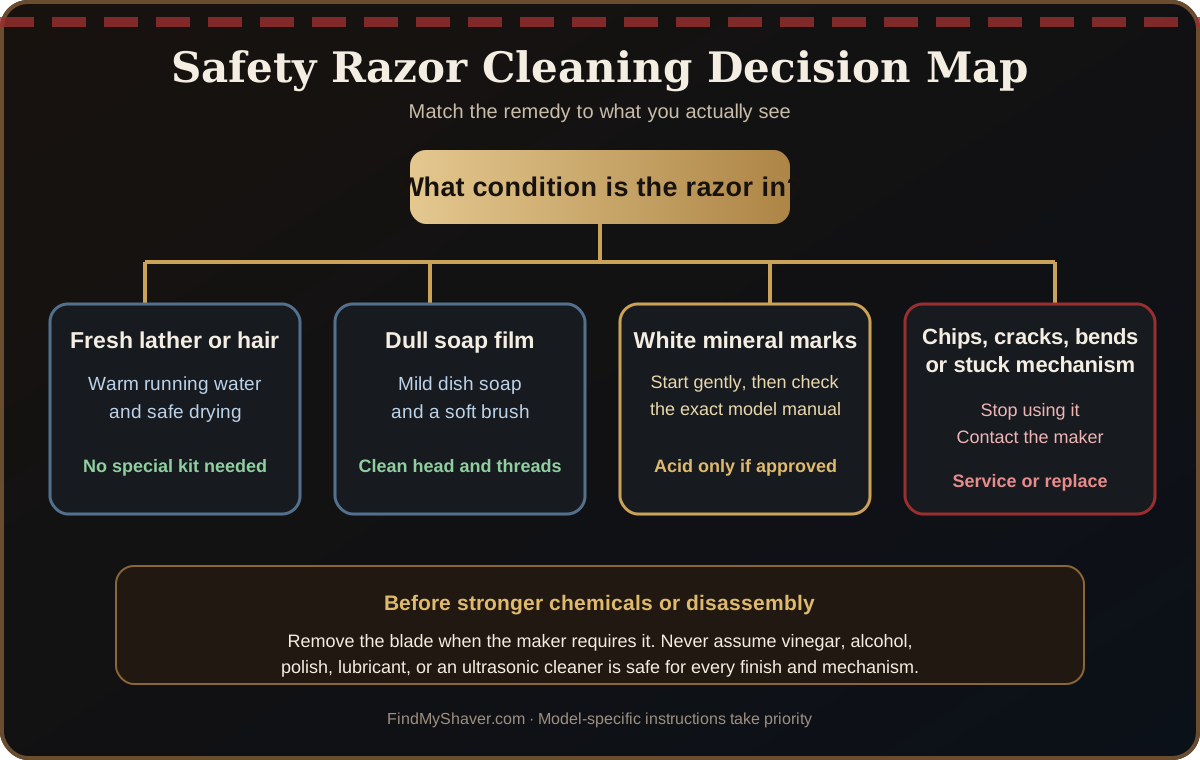
| What you see or need | Start with | Buy something only if | Avoid guessing with |
|---|---|---|---|
| Fresh lather and hair after a shave | Warm running water and safe drying | You lack a secure, dry storage place | A sealed wet travel case |
| Dull or slippery soap film | Mild dish soap and a soft brush | A maker specifies a compatible cleaner | Abrasive paste or a metal brush |
| White hard-water deposits | Mild cleaning, then the exact model's care instructions | The maker approves a particular descaler | Vinegar or acid based only on generic advice |
| Stiff threads or an adjustment mechanism | Clean visible residue and consult the manual | The maker specifies a lubricant or service part | Forcing, flooding, or dismantling a sealed mechanism |
| Chipped plating, bent parts, cracks, or damaged threads | Stop using the razor and contact the maker | An approved replacement head or repair is available | Polishing or scrubbing away the remaining finish |
| A second-hand razor or possible blood exposure | Model-compatible cleaning plus applicable disinfection guidance | You can verify a compatible labeled disinfectant or professional service | Assuming soap or a quick alcohol rinse disinfected it |
This keeps the buying decision tied to the problem. A stand can be convenient, but a razor does not need an expensive display stand if it already has a secure place to dry. A blade bank can make used-blade storage simpler; the important requirement is a rigid, secure container and disposal method accepted where you live. If the head no longer clamps a blade evenly or a moving mechanism stays stiff after maker-approved care, replacement or service is safer than escalating to harsher chemicals.
How to deep-clean the head and threads
You need warm water, a little mild dish soap, a soft toothbrush reserved for cleaning, and a soft cloth. Clean when you change the blade or when you can see or feel buildup. MERKUR offers weekly cleaning as an example for its chrome-plated razors; your shave frequency and water may call for a different interval.
- Remove the blade first. Work over a clear sink or towel with dry hands. Hold a double-edge blade by its short, blunt ends, never by the sharpened long edges. Set a reusable blade somewhere secure; put a spent blade directly into a blade bank or other suitable protective container. MÜHLE's manual explicitly requires blade removal before cleaning its three-piece razor.
- Separate only the parts your design is meant to separate. On a three-piece razor, unscrew the handle and lift off the baseplate and cap. On a two-piece razor, follow its maker's opening method. On a butterfly head, open its doors; do not force apart the mechanism.
- Wash gently. Wet the parts, apply mild soap, and use the soft brush on the underside of the cap, guard openings, handle threads, and other places that collect residue. Let the bristles do the work. Avoid metal picks, scouring pads, and hard pressure on plated surfaces.
- Rinse, inspect, and dry. Remove all soap, check that the head and threads are clear, and let every part dry before reassembly. If a blade is still sound and you plan to reuse it, follow its maker's handling instructions and avoid rubbing a sharp edge. Reassemble without overtightening; MÜHLE warns that excess torque can damage its head thread.
If the razor still tugs after cleaning, inspect the blade and head rather than polishing harder. A damaged or worn blade, trapped hair, incorrect blade seating, or a damaged head can each affect the shave according to MÜHLE's troubleshooting section. If a clean razor still tugs, use our blade replacement guide to decide whether the edge is spent. For cutting angle and head geometry, see our blade gap and exposure guide. If the razor is sound but you want to compare compatible edges, use the DE blade selection guide.
Soap film, hard-water marks, and stains need different responses
A slippery or dull film often clears with mild soap and a soft brush. White deposits may be mineral scale, especially when your tap water is hard. Our hard-water lather guide explains why minerals and traditional soap can leave residue. Start with the gentle cleaning method and a thorough rinse; it is appropriate for more finishes than an acid treatment.
Do not assume vinegar is safe for your razor. MÜHLE's manual prohibits vinegar and acidic detergent on its three-piece razors, and MERKUR says acids and acidic bathroom cleaners damage its plated surfaces. Rockwell separately says a vinegar solution can be used with a nonabrasive soft pad for discoloration on its chrome razors if necessary. Those instructions apply to each maker's own products. Check your exact model, finish, and manual before trying a descaler or polish. If the finish is chipped, the threads are damaged, or the mark looks like corrosion rather than removable film, ask the maker about repair or replacement instead of scrubbing through the coating.
Do not boil the assembled razor, put it in a dishwasher, or use bleach, solvent, abrasive paste, or a metal brush as an improvised shortcut. These are not part of the cited makers' normal cleaning routines and may harm a finish or mechanism.
Cleaning, disinfection, and blade disposal are separate jobs
Rinsing and washing remove hair and soap. Disinfection is a different process and cannot be assumed from a quick splash of alcohol. For a personal razor used on intact skin, routine gentle cleaning and a fresh blade when needed are the practical baseline. Do not share a razor: the CDC advises against sharing razors because contaminated personal items can spread infection. If a razor may have contacted another person's blood, or you need to disinfect equipment for professional use, follow applicable professional rules and a disinfectant label that is compatible with the material; do not rely on a home cleaning routine. The CDC advises checking the maker's instructions and a disinfectant's contact time and surface compatibility.
Treat a used blade as a sharp object even if it looks clean. MÜHLE warns against throwing an uncovered blade away and describes protective packaging or a blade bank. Use a secure blade container, check local disposal rules, and never leave a loose blade in household trash or recycling. The EPA's household sharps guidance explains the injury risk to waste workers from loose sharps.
A clean razor cannot by itself prevent razor burn or ingrown hairs. Pressure, shaving direction, lubrication, and blade condition also matter. If irritation is the reason you are changing your cleaning routine, use our razor burn and ingrown hair guide to check those factors.
A routine you can keep
Rinse and dry after each shave. At blade changes or whenever film appears, take out the blade and give the head and threads a mild-soap clean with a soft brush. Dry the parts and store the razor safely. Reserve stronger treatment for a clearly identified problem and an exact model whose maker permits it. That small routine is easier to repeat than trying to rescue a heavily coated head, and it keeps the blade-handling step deliberate.
Sources: MÜHLE three-piece safety razor manual; MERKUR finish and care guide; Rockwell care guidance; CDC MRSA prevention; EPA household sharps disposal.